
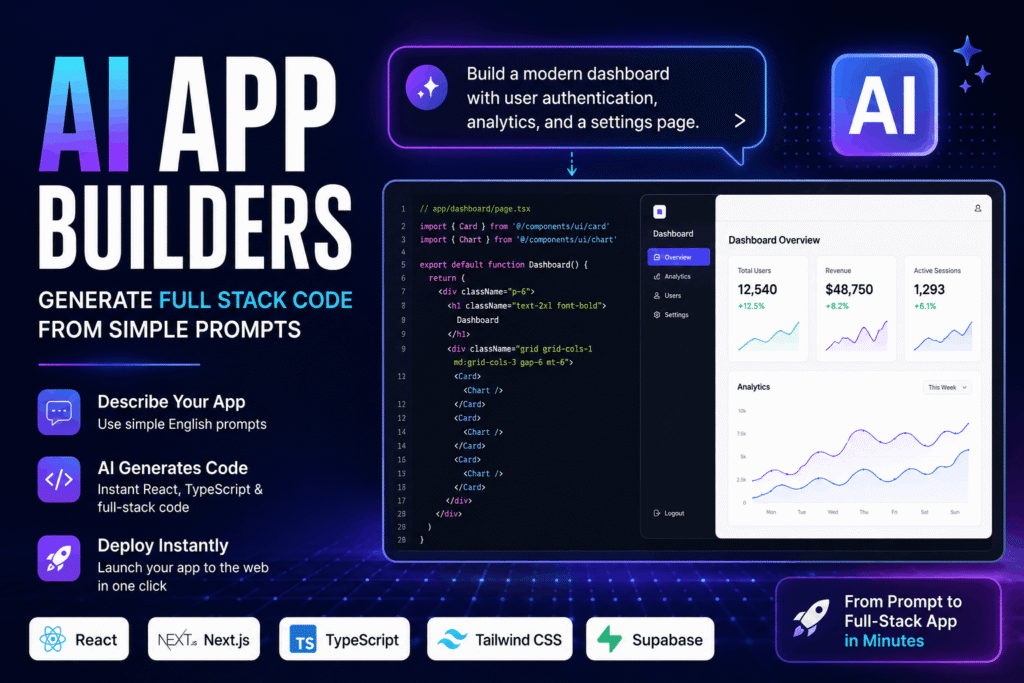
Building a web application used to mean months of writing code and debugging syntax errors — plus, now, you can generate a functional dashboard in ten minutes.
I’ve seen this shift firsthand over the last year. New. I realized that AI app builders completely change how we prototype software.
You probably know someone who’s dealt with endless development delays. As of 2026, entrepreneurs and developers use these workarounds to skip the boring setup.
That’s a significant gap. Jump straight to building features.
You just type what you want in plain English. The AI writes the React and TypeScript code for you.
TL; DR
- AI app builders use models like Claude 3.5 Sonnet to turn plain English prompts into full-stack applications using React and TypeScript.
- The standard stack includes Next.js, Tailwind CSS, and Supabase, allowing developers to own the exported code repository.
- A major bottleneck is the 80/20 wall, where the AI handles the first 80% instantly but the final 20% of custom features requires manual coding.
Quick Action
- Start with a clear, single-sentence prompt to generate your Minimum Viable Product.
- Export the code immediately so you own the repository and can make manual fixes.
- Watch your token usage, because premium AI models like GPT-4o add up fast.
- Expect to hit the 80/20 wall, where simple features work instantly but complex logic fails.
Table of Contents
- What is an AI App Builder?
- How AI App Builders Work in Practice
- Why AI App Builders Matter for Fast Growth
- The Hidden Bottlenecks of AI App Builders
- People Also Ask
- Final Verdict and Next Steps
What is an AI App Builder?
An AI app builder is a platform that taps into large language models to generate functional software applications from natural language prompts. Instead of dragging and dropping elements on a canvas, you describe what you want. The AI writes the actual code in structures like React.
Here’s the thing – these platforms represent a massive shift from traditional no-code tools like Bubble. I remember when no-code was the only option for non-technical founders.
You were stuck with proprietary platforms. If the platform died. AI app builders work out this by writing clean. Standard code that you actually own and can export.
As of 2026, the hottest new programming language is English. Those numbers tell a story.
Still, as Andrej Karpathy famously noted, and and you just type instructions, and the AI builds the database schema. Sets up the server, and deploys the app. This gives you total control over your repository.
You’re generating real code that runs on standard infrastructure. It’s a massive win for founders who want (which completely makes sense logically) to own their intellectual property.
How AI App Builders Work in Practice
AI app builders function by sending your natural language prompts to advanced AI models. Which then generate, preview, and deploy full-stack code automatically, and they standardize on modern tech stacks to make sure compatibility and easy deployment. File that away. You’ll see why it matters in a bit.
In my go through, the process feels like magic at first — you type a ask for to build a customer dashboard with a login screen, and watch the AI spin up the UI. Most top-tier builders use a T3-like stack.
See for yourself. Js for the structure. Tailwind CSS for styling, and Supabase for backend-as-a-service needs.
The AI understands how these pieces fit together perfectly. It knows how to route data and manage state.
It all goes back to that earlier idea, when I tested the Replit Agent, it automated the entire DevOps cycle; it handled the database schema creation, server setup, and deployment without me touching a terminal. Not the easiest thing to wrap your head around. Most people feel the same way about it. This is a huge leap forward for developers who hate configuring servers. However, the AI can forget things.
As your application grows in complexity. You hit the Context Window Limit. Keep that in mind. Now flip that around. The AI begins to forget earlier code instructions. Leading to broken features and duplicated logic.
How does the AI write the code?
5 Sonnet, and GPT-4o to translate your English prompt into syntactically correct React (at least in many practical scenarios) and TypeScript files.
Not exactly what you’d expect. It predicts the necessary components, imports, and styling based on its training data.
When I tested this, the AI preferred a concrete stack. It consistently generated React, Vite, Tailwind CSS, Lucide Icons, and Supabase.
It clicks once you see it in action. This consistency makes the code predictable.
If you want to understand how AI handles website creation more broadly, you can read about AI website builders. The models are fine-tuned to get software architecture. Not just raw code snippets.
This detail matters more than it might seem right now.
Why AI App Builders Matter for Fast Growth
AI app builders matter seeing as they lets near-instant prototyping of Minimum Viable Products, drastically lowering the technical barrier for non-technical founders. Which brings up an interesting point. They handle automated deployment and infrastructure management. Letting you focus on user feedback instead of server configuration.
Speed is everything for a new startup. If you can build a functional prototype in an afternoon.
You can test your ideas faster. I built a functional dashboard in 10 minutes using one of these assets… that speed changes how you approach product development. You no longer wait weeks for a developer to have bandwidth. You can iterate on user feedback the same day you get it.
The cost structure is also different. Vercel v0 pricing is around $20 per month for the Pro tier with 5000 premium credits.
Replit Core costs about $15 per month. Which includes Replit Agent access. Puts things in perspective. These prices are reasonable for entrepreneurs in the US or UK, but the token costs add up fast if you aren’t careful, you need to monitor your usage closely to avoid surprise bills.
| Feature | AI App Builders | Traditional No-Code |
|---|---|---|
| Code Ownership | Yes, you export clean React code | No, locked into the platform |
| Creation Method | Natural language prompts | Visual drag-and-drop interface |
| Technical Barrier | Very low, plain English | Moderate, learning platform rules |
| Stack Standardization | Next.js, Tailwind, Supabase | Proprietary visual logic |
“AI doesn’t just write code; it manages the entire lifecycle from idea to deployment in minutes.” – Amjad Masad, Replit CEO
The Hidden Bottlenecks of AI App Builders
Within this context, sure enough, the main bottlenecks of — actually, that’s not quite right, AI app builders include the 80/20 wall…which means that jumped out at me too. Where the final 20% of custom features needs manual coding. Those numbers tell a story. And a pain debugging processes for logic errors. You also risk accumulating technical debt.
it’s transparent. If the AI takes advantage of outdated or insecure libraries. Hold onto this thought.
You’ll hit a wall. The 80/20 rule applies heavily here.
It’s worth noting that the AI generates the first 80% of your app instantly, so that changes the picture quite a bit. That last 20%?
It constantly takes days of manual coding. I spent two hours trying to fix a single CSS alignment issue that the AI kept getting wrong.
It was deeply frustrating. The AI would fix one thing and break another.
Actually, let me put that differently. But when you need complex backend integrations, the AI struggles.
Across the board, debugging is also a nightmare. When the AI makes a logic error. You’ve to read through code you didn’t write to find the bug.
That’s exactly why having a solid foundation in headless WordPress. Or traditional development is still valuable.
Is an AI app builder worth it for beginners?
Yes, AI app builders are worth it for beginners mostly. Since they lower the technical barrier to entry. And allow non-technical founders to launch functional MVPs without hiring a developer. What this means is then again, beginners must be prepared to learn basic coding concepts to fix the inevitable bugs and finish the final 20% of the application. That’s a significant gap. Keep this in mind; it shows up again soon.
People Also Ask
Can AI app builders replace developers?
No, AI app builders can’t replace developers. Nothing overly complex. Because they still need human intervention for complex logic, security auditing. They’re best viewed as a force multiplier that speeds up prototyping. Not a full replacement for engineering expertise.
How much does it cost to use an AI app builder?
By most accounts, as of 2026, premium tiers — thinking about it more, like Vercel v0 Pro cost around $20 per month. While Replit Core is about $15 per month. 5 Sonnet or GPT-4o can add up quickly. Kind of surprising, right? Meaning heavy anyone on the platform might spend more than the base subscription price.
What programming languages do AI app builders use?
Most AI app builders standardize on a modern JavaScript stack. Basically, generating React, TypeScript, and Tailwind CSS for the frontend. It’s a lot to process. For backend services, they often combine with Supabase. In reality, giving you a full-stack TypeScript application that you can export and own.
Can I export the code generated by an AI app builder?
Yes, one of the biggest advantages of modern AI app builders over traditional no-code platforms is Being able to (and that implies quite a bit) export clean code. Js. Meaning you’re not locked into the platform and can host the code anywhere.
Final Verdict and Next Steps
If you think about it. AI app builders are a massive leap forward for rapid prototyping. But they’re not a silver bullet for full-scale production without developer oversight; you should use them to validate ideas quickly, then — to be more precise, transition to manual development for the final, complex features.
Use an AI app builder to build your MVP. If you only do one thing. You’ll save weeks of setup time.
But remember the 80/20 wall. You’ll need to step in and finish the job yourself.
The transition from no-code to AI-code is a real shift. If you’re building a complex site, you might still need old-school platforms. To give you an idea, knowing how to set up Webflow MCP. Or understanding Wix ecommerce remains relevant for specific use cases.
For raw, fast software prototyping, AI app builders are the new standard.
- Draft a single-prompt MVP — Write a clear, concise prompt that defines your core feature set and user interface requirements.
- Generate and export the code — Use a tool like Lovable or Bolt.new to generate the app, then immediately export the React repository to your own GitHub.
- Test the core functionality — Click through every button and form to identify the 20% of features that the AI failed to implement correctly.
- Plan manual fixes — Allocate time to manually code the complex logic and CSS alignments the AI could not finish.
🔍 Research Sources
Verified high-authority references used for this article



Comments (0)