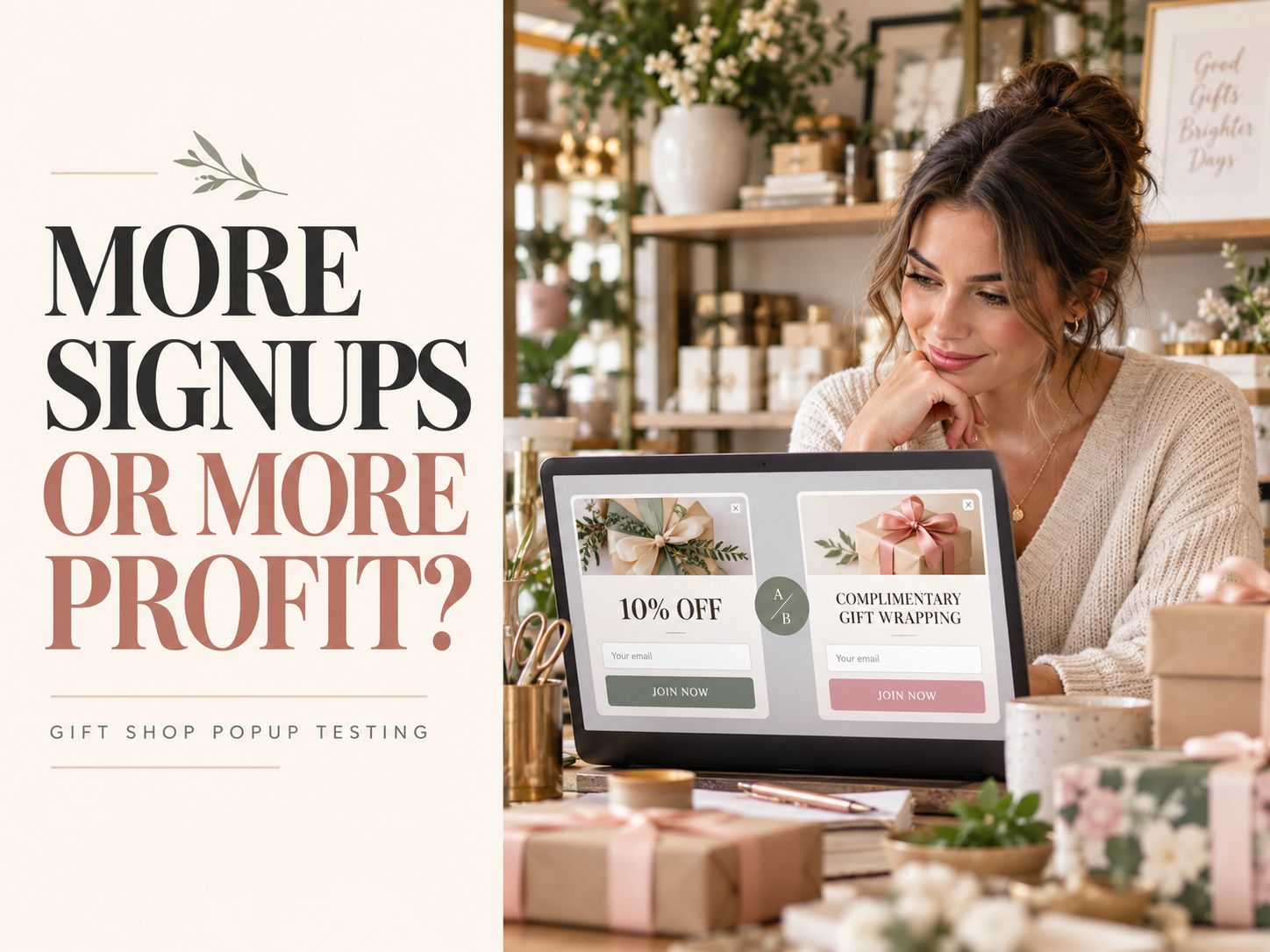
Your gift shop has a visitor who loves a product but isn’t quite ready to buy. Maybe they’re comparing prices. Maybe they’re unsure about delivery. Or perhaps they’re waiting until payday.
A first-order discount might help. But offering everyone 15% off isn’t automatically a good strategy.
This guide explains how to build a gift shop email capture popup first order discount strategy that makes sense for your products, customers, and profit margins. You’ll learn which incentives are worth testing, how to write the popup, when to display it, and what to measure after launch.
What Should a Gift Shop Offer New Email Subscribers?
Start with a reward that fits the kind of gifts you sell and the amount of money you can afford to give away.
For a general gift shop, 10% off is a reasonable starting experiment. A premium handmade store might be better off offering free gift wrapping. A retailer selling inexpensive accessories could test a fixed-dollar discount with a minimum order value.
The offer should feel worthwhile to shoppers without damaging the economics of every first order.
Choose your offer based on your products
| Gift shop type | Offer worth testing | Why it may fit |
|---|---|---|
| General gift store | 10% off first order | Straightforward across varied products |
| Handmade gifts | Free gift wrapping | Adds presentation value without cutting every product’s price |
| Personalized jewelry | Small discount or personalization perk | May protect labor-intensive product margins |
| Gift hampers | $5 off $40+ | Sets a clear order threshold |
| Seasonal gifts | Early access or limited promotion | Matches event-based demand |
| Premium gifts | Complimentary card or gift presentation | Maintains premium positioning |
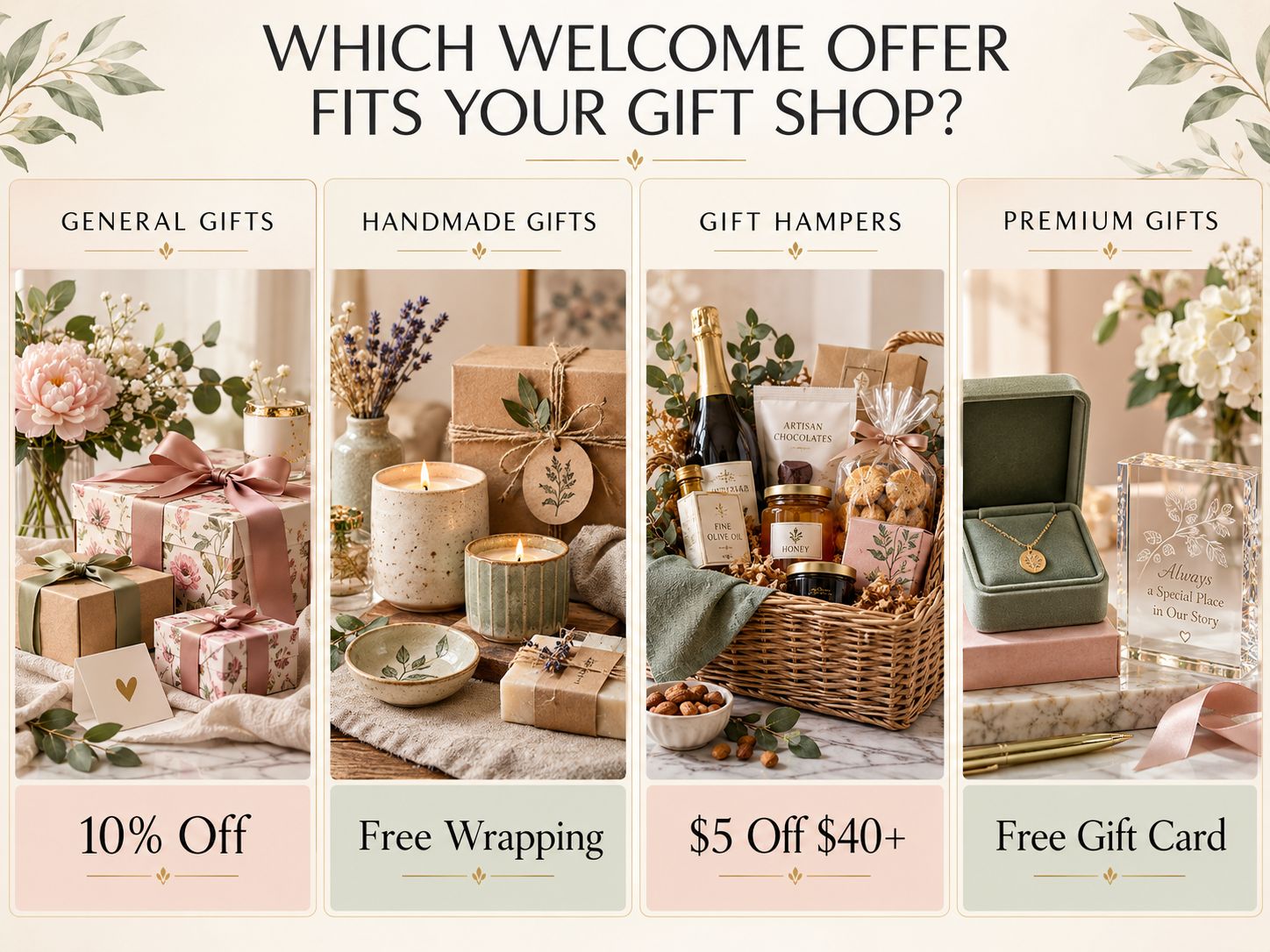
These aren’t industry performance benchmarks. They’re options to evaluate against your actual costs and customer behavior.
Three questions to answer before choosing
First, how much contribution does the average order generate? If a $50 order leaves only $12 after variable costs, a $10 discount consumes most of that amount.
Second, what matters most to your customers? Someone buying a birthday present may care more about timely delivery and attractive packaging than a slightly lower price.
Third, would the customer have bought anyway? A discount offered to an already-committed buyer costs money without necessarily creating another sale.
That final question is easy to overlook.
How Much First-Order Discount Can Your Gift Shop Afford?
Calculate the money remaining after the discount and your variable order costs. This is a more useful starting point than copying the percentage used by another store.
Consider a hypothetical gift box:
| Order component | Amount |
|---|---|
| Selling price | $50 |
| Product cost | $22 |
| Packaging and fulfillment | $6 |
| Other variable costs | $2 |
| Contribution before discount | $20 |
| 10% discount | $5 |
| Contribution after discount | $15 |
This simplified example excludes taxes, returns, fixed overhead, and any costs not entered.
The store has $15 of contribution remaining after the promotion. That’s not necessarily $15 in net profit.
Why the break-even point matters
Now suppose the store normally receives 100 orders with $20 contribution per order.
That produces $2,000 in contribution.
If every order becomes eligible for a promotion that reduces contribution to $15, the store would need approximately 134 orders to exceed that same $2,000 contribution.
That’s about 34% more orders.
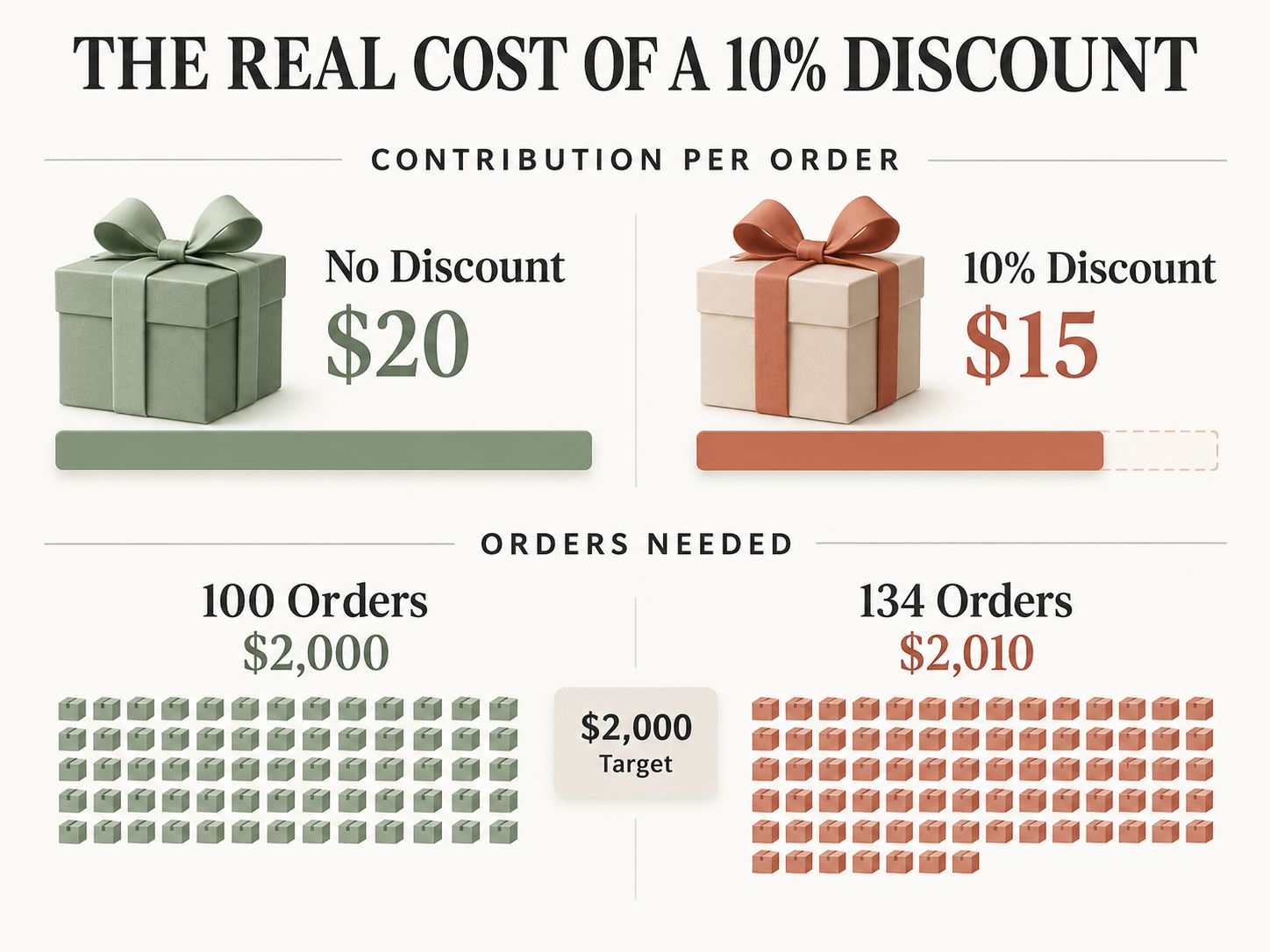
This comparison assumes the same order value and cost structure and that all orders receive the discount. In real campaigns, only some shoppers may redeem it.
The lesson isn’t that a 10% discount is bad. It’s that the sales lift has to justify the incentive cost.
Use the free calculator on this page to compare your own order economics before launching a campaign.
For a broader understanding of how ecommerce platform expenses affect your margins, see our Shopify vs WooCommerce total cost breakdown. You can also explore our calculators and estimators for related planning resources.
What Should Your Gift Shop Email Capture Popup Say?
A good popup makes the benefit obvious in a few seconds. It doesn’t need a long sales pitch.
Think about the visitor’s situation. They came to your shop to find a present, not to join another mailing list.
Make the offer relevant to that shopping task.
Example 1: General gift shop
Headline: A Little Gift for You
Description: Enjoy 10% off your first eligible order. Join our email list for thoughtful gift ideas and special offers.
Button: Get My 10% Off
Small print: First eligible order only. Terms apply. Marketing emails; unsubscribe anytime.
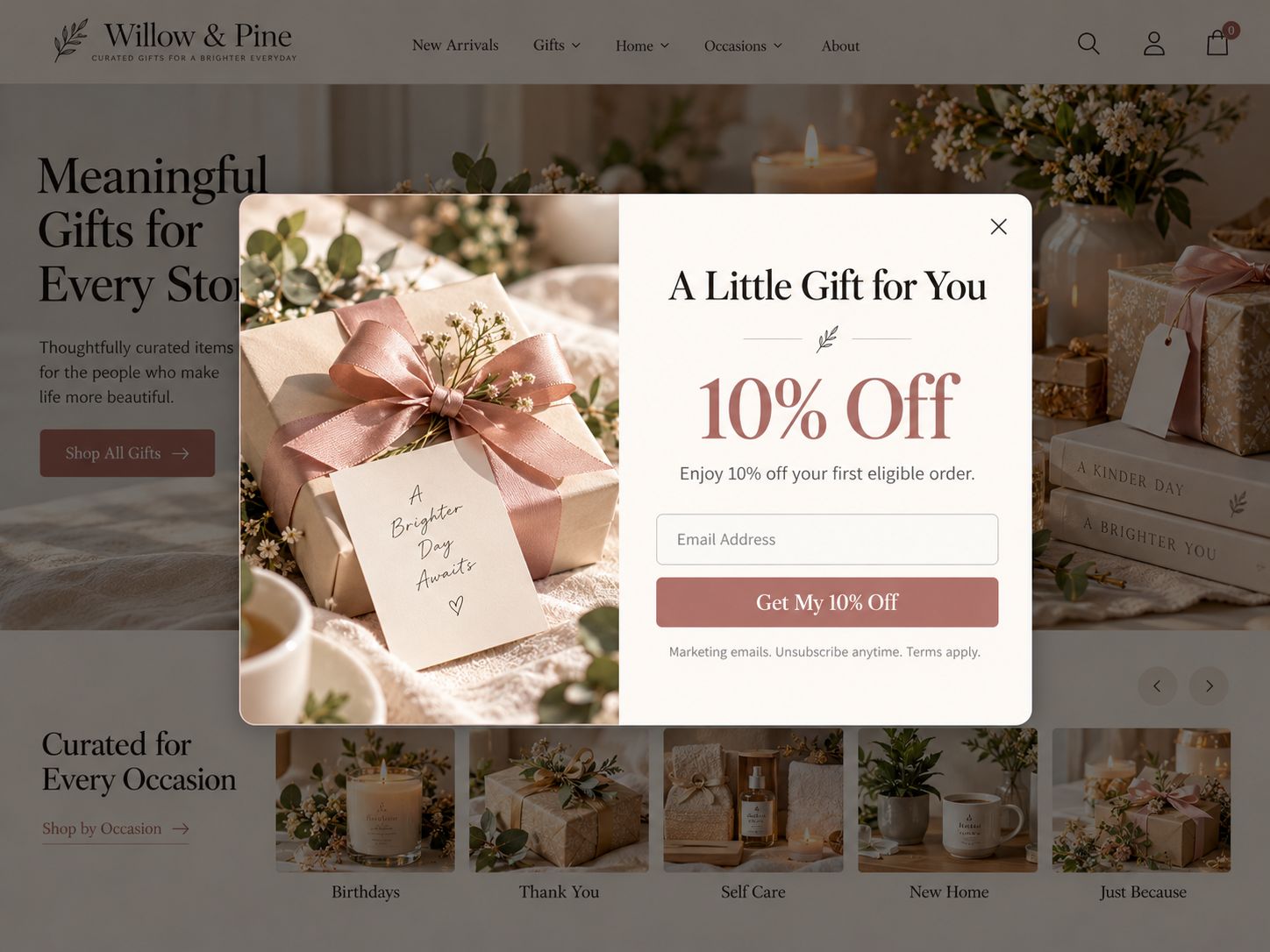
This is a useful starting point for a store selling a wide range of gifts.
Example 2: Handmade gift shop
Headline: Let Us Wrap It Beautifully
Description: Join our email list and enjoy complimentary gift wrapping on your first eligible purchase.
Button: Claim Free Gift Wrapping
This offer emphasizes the experience of giving a gift instead of reducing its price.
Example 3: Birthday gift collection
Headline: Make Their Birthday Special
Description: Find a gift they’ll love. Subscribe and get $5 off your first order of $40 or more.
Button: Unlock My $5 Off
The minimum spend must be visible before signup and honored at checkout.
Example 4: Seasonal gift collection
Headline: Be First to Discover Our Holiday Gifts
Description: Get seasonal gift ideas, collection updates, and subscriber-only offers delivered to your inbox.
Button: Join the Gift List
This version doesn’t promise an immediate discount. It may be more appropriate for a store that wants to build interest before a collection launches.
What makes popup copy effective?
The best examples share three characteristics: a recognizable reward, a clear action, and an honest explanation of the conditions.
Avoid vague buttons such as “Submit” when something like “Get My Welcome Gift” tells the shopper what will happen.
Also avoid claims such as “Today Only” unless the offer genuinely expires that day.
For WordPress stores using custom signup forms, our SureForms two-column form guide provides related form-layout guidance. If you use different ecommerce platforms, the interface and integration steps may vary.
When Should You Show the Email Popup?
Show the popup after the shopper has had a chance to understand what your store offers. The right trigger depends on what they’re doing, not just how many seconds they’ve been on the page.
Consider a visitor comparing personalized anniversary gifts. Interrupting them immediately may be unhelpful. Waiting until they’ve explored a collection gives the promotion more context.
Here are sensible starting experiments:
| Visitor behavior | Trigger to test | Reason |
|---|---|---|
| Browsing the homepage | Delay after initial engagement | Gives the visitor time to explore |
| Reading a gift guide | Scroll-based trigger | Avoids interrupting the introduction |
| Exploring a specific gift category | Contextual collection offer | Matches shopping intent |
| Preparing to leave on desktop | Exit-intent popup | Offers another reason to consider the store |
| Already subscribed | Suppress signup popup | Prevents unnecessary repetition |
| Entering checkout | Avoid disruptive popup | Protects checkout usability |
A 10–20-second delay is an experiment, not an evidence-based universal rule.
On mobile, avoid large overlays that are difficult to close or block important shopping content.
Popup scripts and overlays should also be evaluated for their effect on the shopping experience and page performance. Our guide to optimizing Core Web Vitals on shared hosting covers related performance considerations. You can also explore the website performance category for additional optimization topics.
Should you offer discounts to shoppers who have already added products to their cart?
Be careful.
An add-to-cart event signals interest, but it can also mean the shopper was already willing to pay full price.
If you offer an automatic discount at that moment, you could reduce revenue from a sale you would have received anyway.
Test cart-stage offers separately. Compare the additional completed orders against the total discounts given.
How Do You Deliver the Discount After Signup?
Reveal the reward immediately after a valid signup and send the information by email as a backup.
Consider what happens when a shopper submits their email address, adds a product to the cart, and reaches checkout before the welcome email arrives.
They may stop shopping to find the coupon. Some will come back; others may not.
An immediate confirmation screen reduces that friction.
A simple sequence looks like this:
Signup completed → Discount revealed → Customer continues shopping → Backup email delivered
If your platform supports applying a discount through a checkout link, test it with the actual promotion restrictions before using it publicly.
What should happen when something goes wrong?
The popup should also handle unsuccessful submissions.
If an email address is invalid, show a specific correction message. If someone is already subscribed, explain that their address is recognized rather than silently pretending a new subscription occurred.
If the discount cannot be generated, don’t display a fake success message. Give the shopper a useful explanation and a genuine support route.
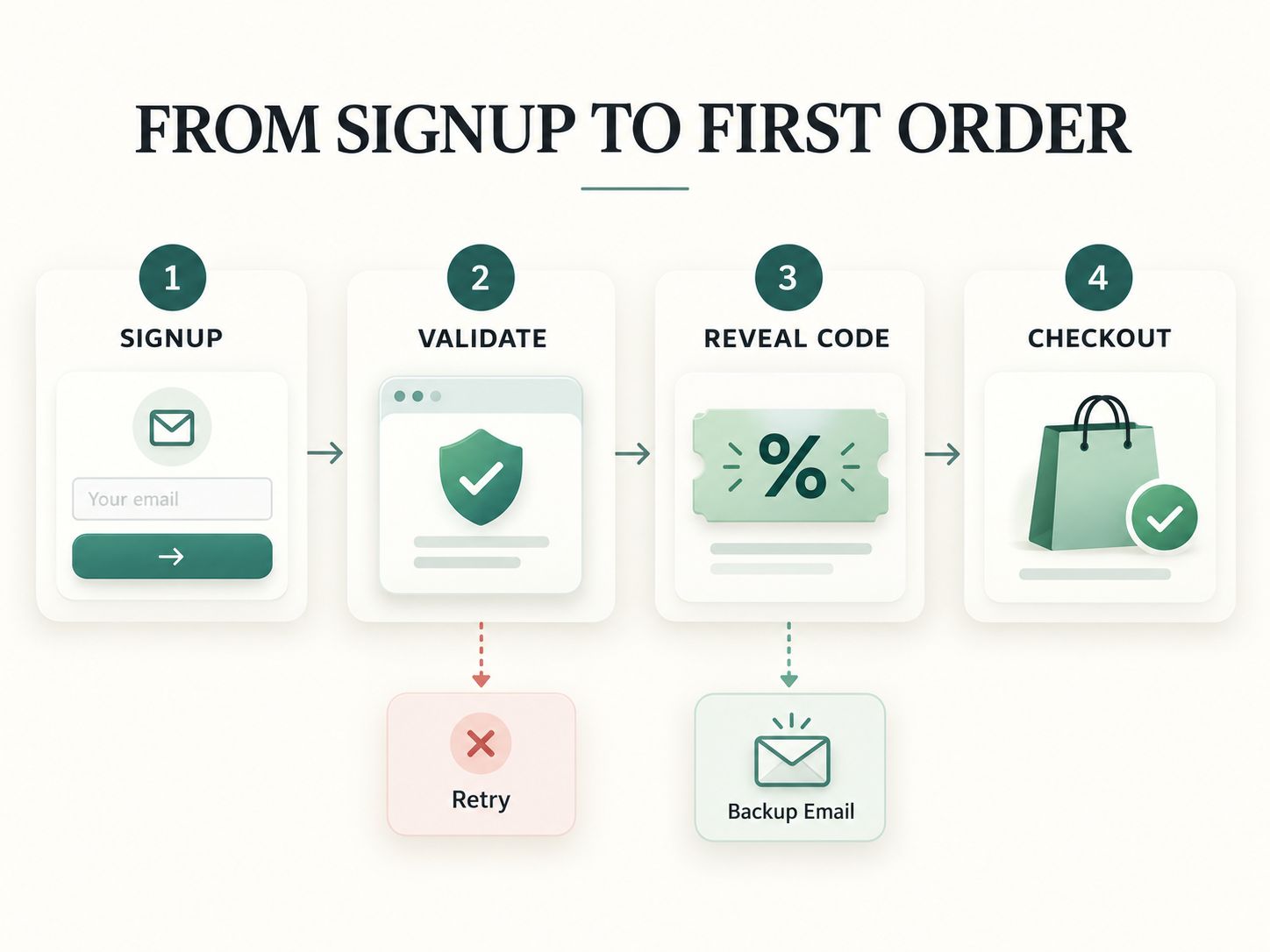
These small details are part of the customer experience, not merely technical maintenance.
How Do You Set Up a First-Order Discount Popup?
The setup has four parts: the discount, the signup form, the email automation, and the checkout test.
The exact configuration depends on your ecommerce platform and the applications you choose.
Step 1: Create the discount
In your ecommerce dashboard, define the offer.
Check its eligibility, minimum spend, excluded products, expiration, usage limits, and compatibility with existing promotions.
A “first-order only” restriction needs particular attention. Some systems rely on customer accounts or email addresses, so they may not recognize every returning shopper.
Step 2: Configure the signup form
Use a clear headline, one primary email field, a meaningful button, and appropriate marketing consent information.
Make sure the popup can be operated with a keyboard and dismissed on both desktop and mobile.
Don’t ask for a name, phone number, birthday, and gift preferences unless you have a real reason to collect them.
Step 3: Connect the email workflow
Connect your form to the email marketing service, configure the subscription handling, and decide what should happen after a successful signup.
Create a welcome email containing the promised offer and clear redemption instructions.
Keep transactional customer communications separate from marketing messages as appropriate.
Step 4: Test the complete journey
Before launch, check these situations:
- New visitor signs up successfully.
- Existing subscriber returns.
- Customer has already purchased.
- Coupon has expired.
- Cart contains an excluded product.
- Minimum spend has not been met.
- Email delivery is delayed.
- Shopper uses a mobile device.
- Customer closes the popup without subscribing.
The campaign isn’t ready merely because the popup opens and closes correctly.
It’s ready when the customer can actually use the offer under the conditions you’ve advertised.
For WordPress and WooCommerce stores, consider testing checkout-related changes in a separate staging environment. Our WordPress staging setup guide explains the staging approach, while the WordPress website quality control guide provides a broader testing reference.
What Should Your Welcome Email Include?
Your first email should deliver the promised incentive and make it easy to return to the store.
Keep it short. The subscriber probably remembers why they signed up.
Sample welcome email
Subject: Your little welcome gift is here 🎁
Hi there,
Thanks for joining our gift-loving community.
Here’s 10% off your first eligible order.
Your discount code: WELCOME10
Whether you’re planning a birthday surprise or looking for something thoughtful, we’d love to help you find the right gift.
Explore Our Gifts →
Offer terms and exclusions apply.
See you soon,
The Gift Shop Team
WELCOME10 is an example code. Create and verify it before sending. The real email must also include applicable sender identification and unsubscribe information.
What should you send afterward?
Don’t send repeated coupon reminders without offering anything useful.
Your next email might share birthday gift ideas, a guide to choosing personalized presents, or information about shipping and gift wrapping.
Send a reminder before a genuine discount expiration if the subscriber has not purchased and the reminder is appropriate.
After a customer buys, stop treating them like someone who still needs their first-order incentive.
How Do You Measure Whether the Popup Is Successful?
Measure subscriptions, purchases, discount costs, and contribution together.
A campaign with a high signup rate may still be disappointing if subscribers never purchase or every order loses money.
Start with these measurements:
| Metric | Calculation |
|---|---|
| Popup opt-in rate | Signups ÷ eligible popup views × 100 |
| Subscriber purchase rate | Purchasing subscribers ÷ subscribers × 100 |
| Redemption rate | Redeemed codes ÷ issued eligible codes × 100 |
| Average order value | Order revenue ÷ number of orders |
| Contribution per order | Net order revenue minus variable order costs |
| Revenue per eligible visitor | Attributed revenue ÷ eligible visitors |
Choose a consistent attribution window and avoid counting the same purchase multiple times.
For stores evaluating organic traffic alongside conversion performance, our Shopify collections SEO guide covers related collection-page optimization, and the SEO and metadata tools category provides additional resources.
A practical campaign example
Suppose two promotions receive comparable visitor traffic.
Campaign A gives 15% off and attracts more subscribers.
Campaign B offers free gift wrapping and attracts fewer subscribers.
Which is better?
You cannot answer from signups alone.
You need to know how many customers purchased, how much they spent, what each incentive cost, and whether the offers generated additional sales.
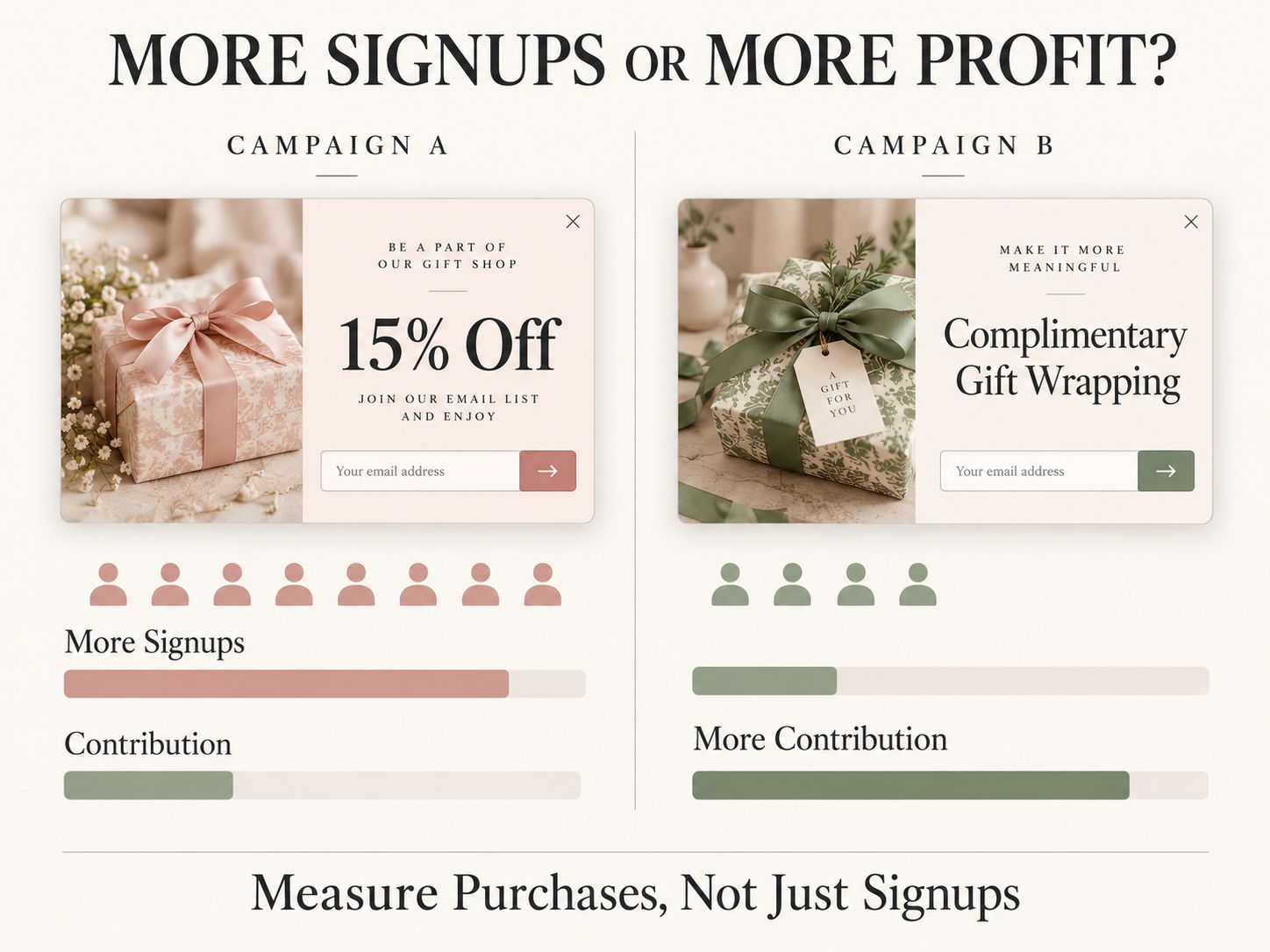
A promotion that collects fewer email addresses could still be more valuable.
What Should You Test First?
Begin with the variable most likely to affect your business: the incentive.
For a handmade gift store, that could mean testing 10% off against complimentary gift wrapping.
For a shop selling gift hampers, it could mean testing a percentage discount against $5 off a minimum order.
Keep the rest of the experience similar while comparing the offers.
Next, test when the popup appears. Then experiment with the headline or form design.
Avoid changing the incentive, trigger, and layout at the same time. If performance improves, you won’t know which change made the difference.
Also remember that a handful of orders isn’t enough to establish a reliable winner. Smaller stores may need a longer testing period or should treat results as directional rather than conclusive.
What Email Marketing Rules Apply in the USA and EU?
Email capture involves more than collecting an address. Stores must handle marketing permissions, personal information, and unsubscribe requests according to applicable laws.
United States
Under the CAN-SPAM Act, covered commercial marketing emails must comply with requirements relating to truthful sender information, non-deceptive subject lines, a valid postal address, and opt-out mechanisms.
The FTC states that covered opt-out requests must be honored within 10 business days.
European Union
For EU audiences, GDPR requirements apply to the processing of personal data. When consent is required and used, it must be informed, specific, freely given, and indicated through a clear affirmative action.
Electronic direct marketing also falls under applicable ePrivacy and national legislation, including some exceptions for existing customer relationships.
Do not assume a marketing rule applies identically in every EU country or that purchasing a product automatically authorizes an unrestricted newsletter subscription.
Explain the marketing purpose clearly, maintain appropriate records, and provide an effective way to unsubscribe.
Visitors should also have access to the website’s privacy policy wherever personal information is collected.
Common Mistakes That Can Undermine a Gift Shop Popup
Offering the biggest discount you can think of. Customers may appreciate it, but your business must still earn enough from the resulting orders.
Showing the same generic message everywhere. A birthday shopper and a corporate gift buyer may need different information.
Making customers wait for their coupon. When possible, show the code immediately and email a backup.
Forgetting existing subscribers. Repeated signup requests make the store feel less thoughtful.
Hiding promotional restrictions. Customers should understand minimum spends, exclusions, and expiry conditions before checkout.
Treating every subscriber as a new customer. Someone may have subscribed previously or purchased using another address.
Judging success by opt-ins alone. The real business outcome includes purchases, incentive costs, and contribution.
A popup is only useful when it helps the shopper and supports the economics of the store.
Frequently Asked Questions
How do I write an email asking for a discount?
Keep it polite and specific. For example: “I’m interested in ordering your personalized gift box. Do you offer a first-time customer discount?” Mention the product and thank the retailer for considering the request.
What are the 5 T’s of email marketing?
There isn’t a single universally recognized set. One useful framework is Targeting, Timing, Tone, Testing, and Tracking. These represent choosing the right audience, sending at an appropriate time, communicating clearly, testing improvements, and measuring results.
How do I write an email offering a discount to a customer?
Put the benefit near the beginning, explain how to claim it, and disclose important restrictions. Keep the email concise and include a direct link to relevant products or collections.
How do I write an email to attract customers?
Lead with something the customer values: a gift idea, a relevant collection, helpful delivery information, or an honest promotional offer. Use a specific subject line and a clear call to action.
Is 10% off enough for a first-order gift shop popup?
It may be. The right incentive depends on your products, customers, margins, and existing promotions. Test 10% against other offers rather than assuming a larger discount will generate more profitable sales.
Should I offer free shipping or a first-order discount?
Compare the cost of shipping with the discount amount and consider what matters to customers. Free shipping may be attractive for small gifts, but its cost can vary considerably by destination and order size.
Should I show an email popup on mobile?
You can, but it should be easy to close, accessible, and sized appropriately. Avoid blocking important content or interrupting checkout.
Can I create a popup without paying for an expensive app?
Depending on your platform, existing plugins, and technical requirements, you may be able to use built-in features, a free-tier application, or a custom form. Check the current limits and capabilities before committing.
Do I need to ask subscribers for their birthdays?
Not necessarily. Collect additional information only when it supports a clear purpose. Starting with an email address can keep the initial interaction simple.
How do I stop customers from using a first-order discount repeatedly?
Use the eligibility rules and redemption controls offered by your platform. Unique codes and customer restrictions can reduce misuse, although no single control necessarily prevents every duplicate account or email scenario.
Final Verdict: What Should Your Gift Shop Try First?
If you’re launching your first email popup, resist the temptation to build a complicated campaign.
Choose one offer with acceptable economics. Write a clear message that matches your products. Show it after meaningful visitor engagement, and make the reward easy to redeem.
For a general gift shop, 10% off may be a sensible first test. For a handmade or premium store, try a thoughtful perk that protects your margins. For gift bundles, consider a minimum-spend discount.
Once the campaign is running, judge it by the customers it helps convert and the contribution those orders generate—not merely the size of your mailing list.
Shareable Insight: The best first-order offer isn’t necessarily the biggest discount. It’s the offer that helps win profitable customers.
What first-order offer has worked best for your gift shop? Share your discount, free-shipping, or gift-wrapping experience in the comments. Your results may help another store owner choose a smarter starting point.