

Choosing a payment gateway for a Kenyan small-business website sounds simple until you start comparing the details.
One provider has attractive M-PESA pricing. Another handles cards better. Some publish their fees clearly; others ask merchants to request a quote. And sometimes even a provider’s own pages disagree with each other.
For most Kenyan small businesses, the practical shortlist includes Paystack, Pesapal, Flutterwave and IntaSend, with direct Safaricom M-PESA integration through Daraja worth considering when you need a more customized M-PESA-only setup.
The important question is not “Which gateway is best?”
Which payment setup fits the way my customers actually pay, works properly with my website, and gives me terms I can verify today?
The Short Answer
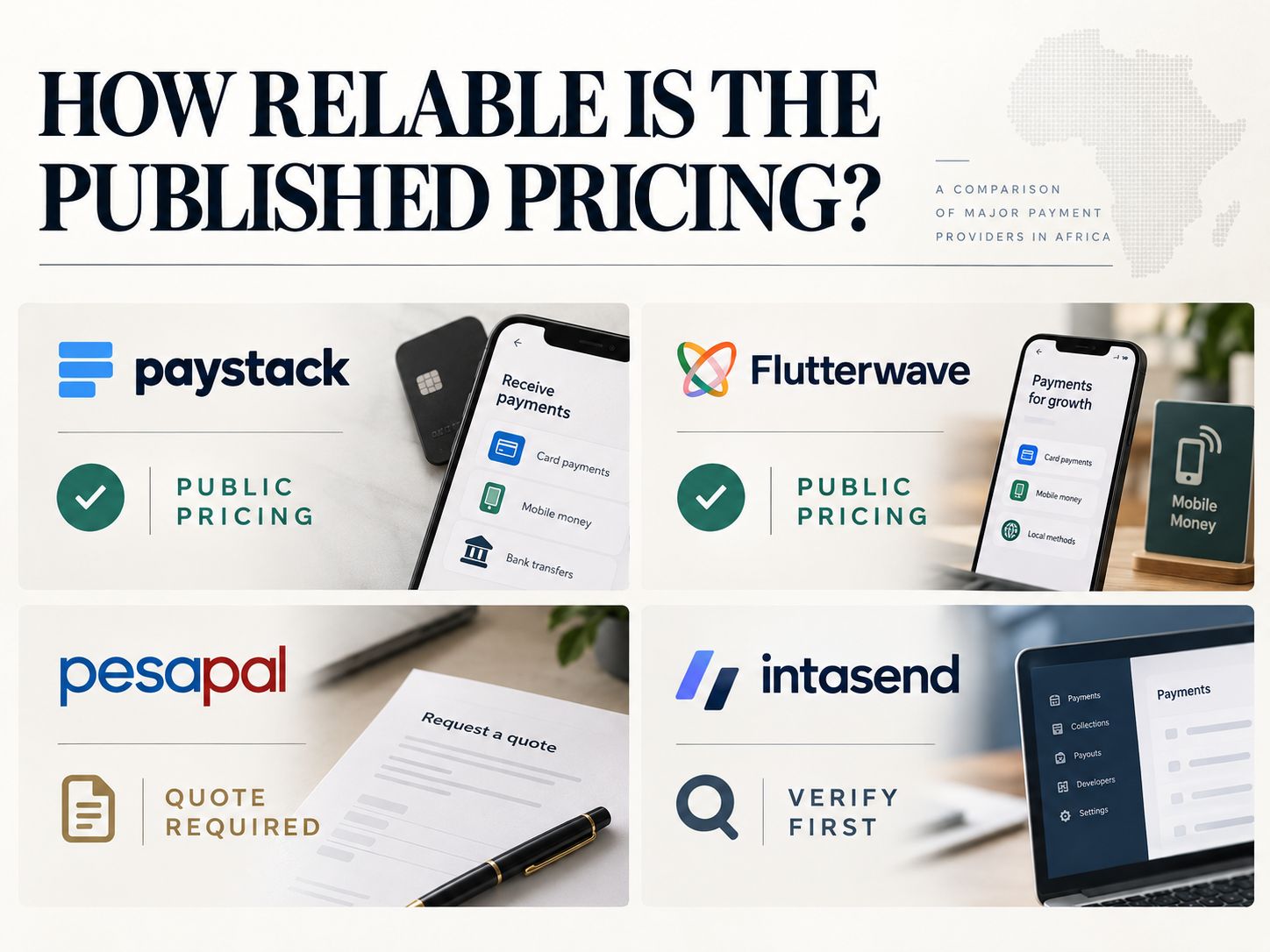
Paystack currently has the clearest published Kenya pricing among the providers reviewed here: 1.5% for M-PESA, 2.9% for local cards and 3.8% for international cards, with automatic settlement in two working days.
Flutterwave publishes 2.9% for local wallets/mobile money, 3.2% for local cards and 4.8% for international transactions. Its Kenya pricing page says local payments settle the next day and lists KES 100 transfer fees to bank accounts and mobile money.
Pesapal supports online payments, payment links, mobile money, cards, bank transfers, WooCommerce and Shopify integrations, but its public pages reviewed for this article do not expose a single percentage schedule that can be compared fairly with Paystack or Flutterwave.
IntaSend requires extra caution because its own current public information is inconsistent. Its support documentation says M-PESA collections cost 1%, while its pricing page currently displays 3%. Its homepage also says card payments are currently unsupported, despite other IntaSend pages mentioning cards. Verify the actual merchant terms before using an IntaSend percentage in your calculations.
Kenya Payment Gateway Comparison
| Provider | M-PESA / Mobile Money | Local Cards | International | Settlement / Key Note |
|---|---|---|---|---|
| Paystack | 1.5% | 2.9% | 3.8% | T+2 automatic settlement |
| Flutterwave | 2.9% | 3.2% | 4.8% | Local payments: next day |
| Pesapal | Ask for current merchant pricing | Ask | Ask | Payment Page states 2-business-day withdrawal |
| IntaSend | Official pages currently conflict: 1% vs 3% | Availability information also conflicts | Verify directly | Obtain current merchant terms first |
This table intentionally distinguishes a verified public fee from a number that needs confirmation.
That may look less tidy than the tables in some comparison articles, but it is much more useful than presenting an outdated or contradictory figure as fact.
Start With M-PESA, Not With the Card Fee
A Kenya-first ecommerce checkout should be designed around the payment method your customers are most likely to use.
That often means thinking about M-PESA before anything else.
The technical experience also matters. A customer should not have to leave your website, copy a Paybill number manually, remember an account reference and then return to the store hoping the order has been recognized.
A good STK Push flow is much simpler:
Customer enters phone number → receives M-PESA prompt → approves payment → gateway confirms transaction → website updates the order.
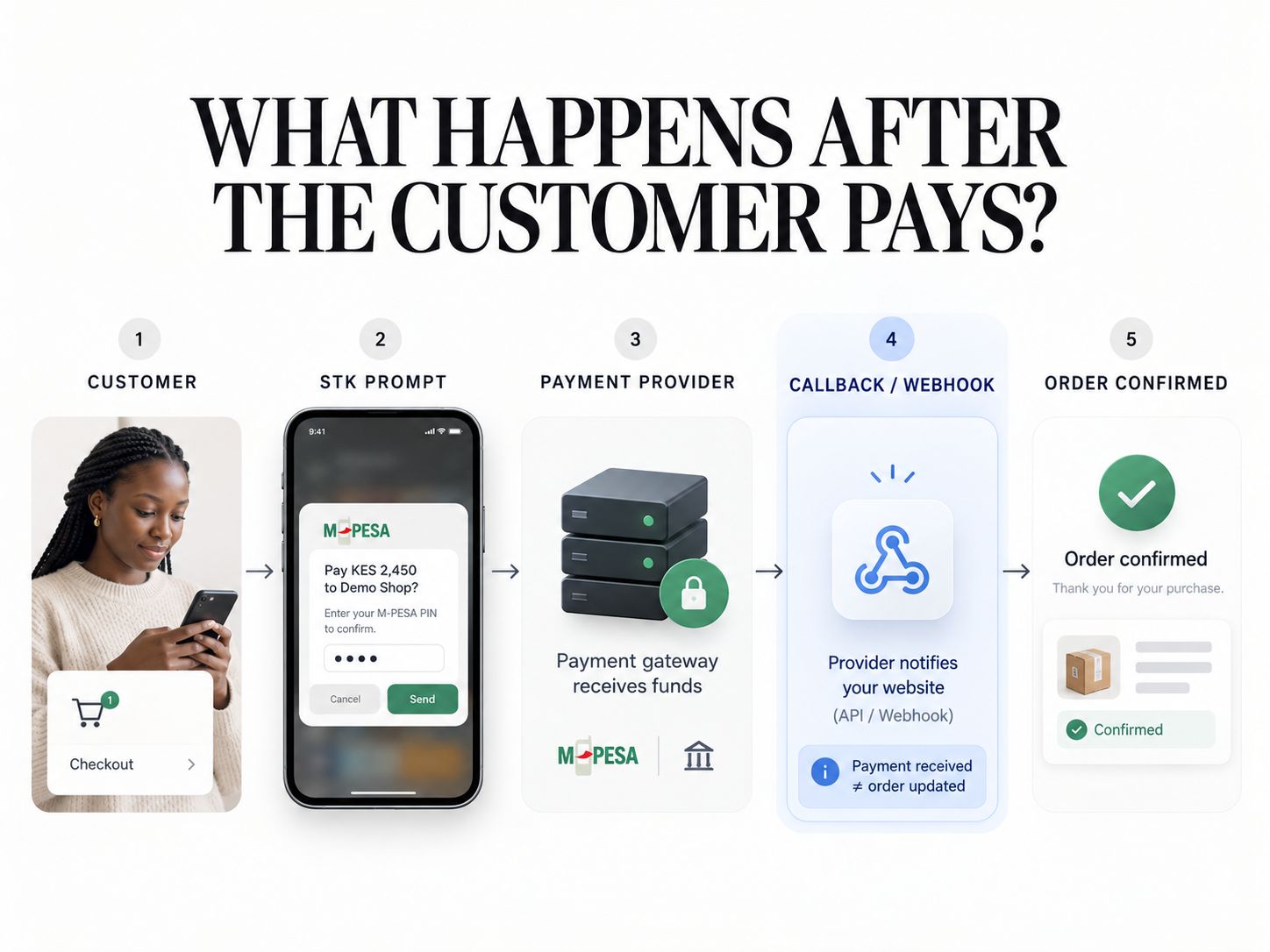
That final step is where many weak implementations fail.
A gateway can successfully receive money while the ecommerce platform still thinks the order is unpaid because the callback, webhook or transaction verification process did not complete correctly.
That is why I would judge a payment setup by more than the percentage fee.
Paystack: The Clearest Published Pricing of the Main Options
Paystack is easy to compare because its Kenya pricing is public.
Its current page lists:
- M-PESA: 1.5%
- Local cards: 2.9%
- International cards: 3.8%
Paystack also says there are no integration or maintenance fees and that settlements automatically reach the merchant’s bank account or M-PESA wallet in two working days.
For businesses doing significant volume, Paystack also states that volume discounts may be available.
This makes Paystack comparatively easy to model before you apply.
A Simple Example
Suppose your website processes KES 400,000 of M-PESA transactions in one month.
At a published 1.5% collection rate, the basic processing amount would be approximately:
KES 6,000
That calculation does not include every possible operational cost, but it gives you a useful baseline.
What I like about this approach is that you can calculate costs before speaking to sales rather than relying on a vague “competitive pricing” claim.
Paystack Payments Kenya Limited also appears in CBK’s May 15, 2026 Directory of Authorized Payment Service Providers as a provider approved to facilitate payment processing on behalf of merchants.
Pesapal: Strong When You Need More Than a Website Checkout
Pesapal becomes particularly interesting when payments do not happen only inside a conventional ecommerce checkout.
Its current Kenya pages support online payments, payment links, cards, mobile money, bank transfers and multiple merchant tools. Its API/plugin page specifically mentions integrations for WooCommerce, Shopify and custom-built websites.
Its Payments Page can also be shared with customers through channels such as WhatsApp, allowing businesses to collect money even when the customer is not checking out directly on the website.
That can be useful for businesses that sell through several channels at once.
For example, someone might discover a product on Instagram, ask a question through WhatsApp, and then receive a payment link rather than being sent back through a full storefront.
What About Pesapal Fees?
This is where I would resist copying a percentage from another comparison website.
The Pesapal pages reviewed here describe straightforward transaction pricing but do not publish one universal Kenya percentage schedule comparable with Paystack’s public table.
Ask Pesapal for a current merchant quotation and compare the actual offer you receive.
Pesapal Limited is also explicitly listed in the May 15, 2026 CBK PSP directory for mobile-money processing and merchant-payment services.
Flutterwave: Worth Comparing When Your Business Extends Beyond Kenya
Flutterwave’s current Kenya pricing is also public.
Its page lists:
- Local cards: 3.2%
- Wallets and mobile money: 2.9%
- International transactions: 4.8%
It also lists KES 100 per transfer to a bank account or mobile money and states that the displayed pricing excludes VAT and other applicable local taxes.
Flutterwave says local payments are received the next day, while international settlement timing varies by region.
That makes it especially worth investigating when Kenya is part of a larger multi-market strategy rather than the only country you serve.
There is an important regulatory-due-diligence point here.
When checking CBK’s directory, verify the exact legal entity shown in your Flutterwave merchant agreement rather than searching only for the consumer-facing brand name. The public CBK document reviewed for this article does not list “Flutterwave” under that exact brand name. That fact alone is not enough to conclude anything about a provider’s regulatory arrangement, because payment businesses may operate through separately named legal entities or partners.
Ask the provider which licensed entity will process your Kenyan transactions, then verify that entity.
IntaSend: Useful Features, but Verify the Current Commercial Terms
IntaSend has several characteristics that are attractive to Kenyan ecommerce merchants.
It offers a WooCommerce plugin, a Shopify integration, sandbox testing and M-PESA functionality. Its WooCommerce page specifically promotes M-PESA checkout without requiring merchants to build directly on Safaricom’s APIs.
The complication is its current public pricing information.
At the time of this review:
- Its support article says M-PESA collections are 1%.
- Its main pricing page displays M-PESA at 3%.
- Its homepage says card payments are currently not supported, while several other IntaSend pages still mention cards.
That is too much inconsistency to ignore.
I would not publish a claim that IntaSend is the “cheapest gateway” based on the 1% support article alone.
If IntaSend interests you, get the current pricing and payment-method availability in writing from the merchant onboarding team and base your comparison on that offer.
That is a more reliable decision than trusting whichever IntaSend page happens to appear first in Google.
What About Direct M-PESA Integration With Safaricom Daraja?
A third-party gateway is not your only option.
Safaricom’s Daraja 3.0 provides APIs that allow developers to connect M-PESA functionality directly to web and mobile applications. Safaricom also provides a sandbox for developers to simulate and test integrations.
Safaricom Daraja Developer Portal
A direct Daraja integration can make sense when:
- M-PESA is central to the product and you have developers who can maintain the payment logic.
- You need custom M-PESA workflows.
- You do not need one provider to handle multiple payment methods.
A multi-method gateway is usually easier when you want M-PESA, cards, reporting, refunds and additional payment methods under one merchant account.
The technical question is not whether direct integration is “better.”
It is whether the extra control is worth the additional engineering and maintenance responsibility.
Which Payment Gateway Fits Your Situation?
The fastest way to narrow the choice is to start with the payment pattern rather than the company name.
| Your Situation | Providers to Investigate First | Why |
|---|---|---|
| Mostly Kenyan M-PESA + cards | Paystack, then compare current IntaSend terms | Paystack has clear public rates; IntaSend needs direct verification |
| Website + WhatsApp/payment links | Pesapal | Multiple payment workflows beyond a standard checkout |
| Kenya plus wider regional payments | Flutterwave | Broader multi-market payment infrastructure |
| Custom M-PESA-heavy application | Daraja or gateway API | Greater control may justify direct integration |
| WooCommerce store | Paystack, Pesapal, IntaSend, plus any currently supported provider | Plugin/API quality and callback reliability matter |
| Shopify store | Confirm the provider is currently supported for your Kenya setup | Platform compatibility can eliminate otherwise attractive options |
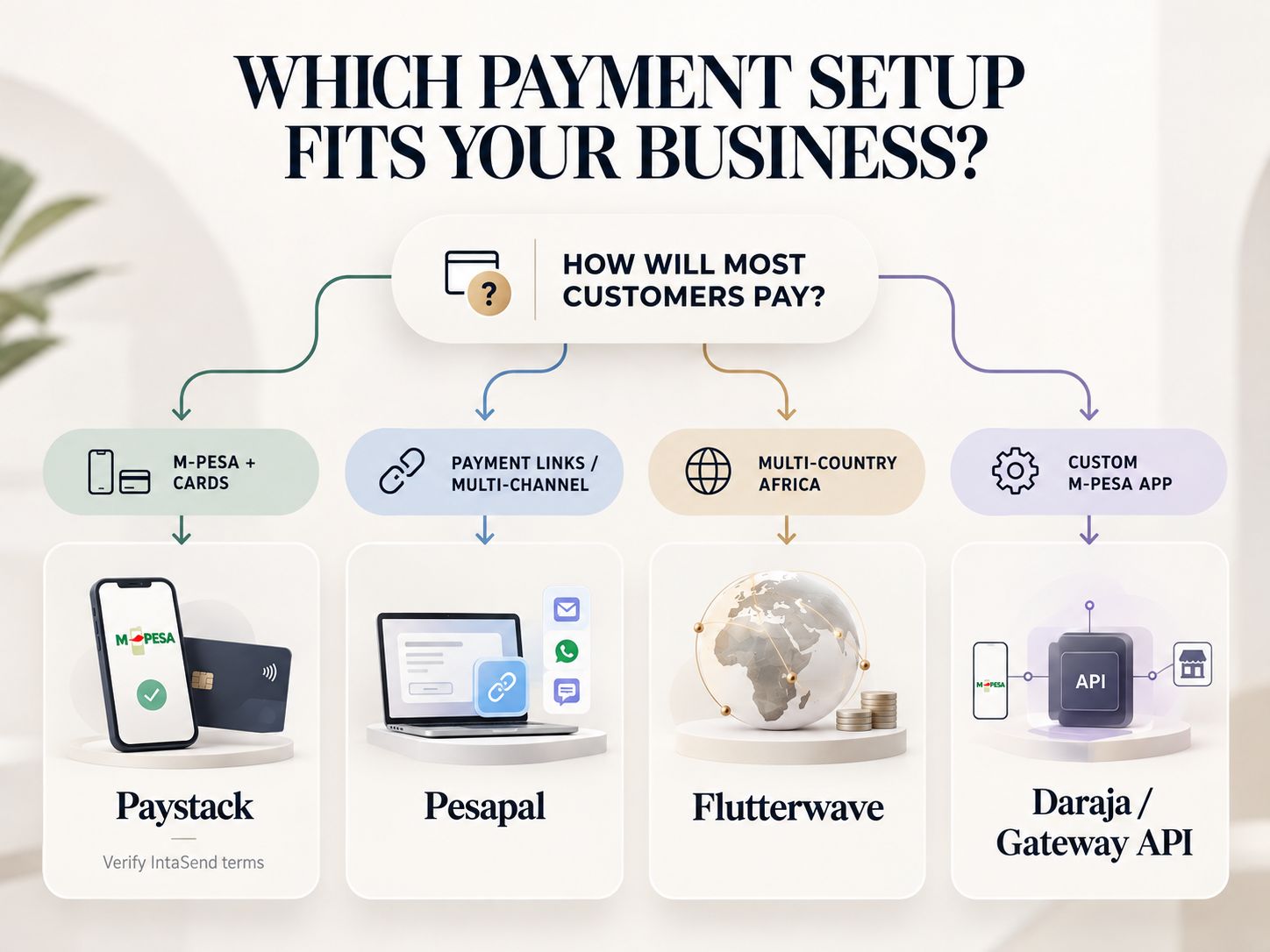
A user arriving from Google should be able to use this table to build a shortlist in a few minutes.
The next step is not immediately opening an account.
The next step is calculating the real cost.
Calculate Cost Using Your Own Payment Mix
Imagine a store expecting KES 600,000 in monthly online sales.
Suppose 75% is M-PESA, 20% is local cards and 5% is international cards.
You should calculate each gateway against those percentages rather than comparing one headline number.
For Paystack, for example, the published rate structure means the M-PESA portion, local-card portion and international-card portion would each attract a different percentage.
This produces a much more realistic estimate than asking, “Which gateway charges less?”
Also ask about items that may not appear in the headline collection percentage: withdrawal fees, transfer fees, taxes, chargebacks, refunds, currency conversion, minimums, negotiated volume pricing and settlement timing.
For broader cost modelling and platform comparisons, the site’s comparison resources and calculators and estimators provide additional context.
Check the Legal Entity Before You Sign
Payment gateways handle money, so the legal name matters.
The Central Bank of Kenya maintains a directory of authorized Payment Service Providers and their approved services. The directory reviewed for this article is dated May 15, 2026.
Central Bank of Kenya National Payment System information
When onboarding with a provider, find the legal company name in your merchant agreement.
Then compare that name with the relevant CBK records rather than assuming the brand and legal entity will always be identical.
This is a small step that makes the regulatory check much more meaningful.
WooCommerce Integration: The Plugin Is Only the Beginning
WooCommerce gives developers considerable checkout flexibility. Developers working with engineering resources and technical tutorials will recognize how much the surrounding implementation matters.
That flexibility is useful, but it also means you have more opportunities to configure something incorrectly.
From my work with WordPress and WooCommerce, the gateway itself is rarely the only thing that needs testing.
The entire transaction lifecycle matters.
| Test | What You Need to Confirm |
|---|---|
| Successful payment | Order becomes paid exactly once |
| Customer cancellation | Order does not become falsely paid |
| STK timeout | Customer can retry safely |
| Declined card | Store displays a useful failure state |
| Delayed webhook | Order updates correctly when confirmation eventually arrives |
| Duplicate webhook | Order is not duplicated or double-processed |
| Refund | Gateway and store records remain synchronized |
| Mobile checkout | Flow works on an actual phone |
| Email confirmation | Customer receives the correct status |
| Inventory | Stock changes only when intended |
If your store is built on WordPress, the site’s WordPress architectural deep dive provides additional context around the platform’s underlying structure.
Caching Can Quietly Break Payments
A fast ecommerce site is valuable.
Caching the wrong endpoint is not.
Cart, checkout, callback, webhook and customer-specific pages require careful treatment. A cache rule that works beautifully for a blog page can create serious problems when applied to a transaction endpoint.
If you are optimizing the store, the WebPlatformLab guide to optimizing Core Web Vitals on shared hosting is useful for performance work, while the performance section provides additional optimization resources.
The goal is not a perfect speed-test screenshot.
The goal is a fast store whose checkout still works.
Security Matters Even When the Gateway Is Secure
Using a payment processor does not automatically make the rest of your website secure.
The website still has administrator accounts, plugins, API credentials, scripts, configuration files and hosting infrastructure.
Never expose gateway secret keys in browser-side JavaScript, screenshots, public repositories or shared documents.
For developers working around configuration and code generation, the site’s code generators and developer utilities provide related resources.
Security around the website does not replace the gateway’s own controls, but both layers matter.
What If You Are Choosing Between Shopify and WooCommerce?
Platform choice can change your payment options.
WooCommerce generally gives developers more control over plugins, callbacks and server behaviour. Shopify provides a more managed ecommerce environment but places more constraints around payment integrations and checkout architecture.
WebPlatformLab’s current Shopify vs WooCommerce total cost breakdown gives useful architectural context.
Choose the store platform and payment strategy together.
Otherwise, you can spend weeks building a store before discovering that the payment workflow you planned is awkward or unavailable on that platform.
What About Wix, Webflow or Framer?
The same principle applies to other hosted and visual-development platforms.
Before committing to one, confirm what payment providers and custom integration methods are available for your target country.
The site’s Webflow vs Framer comparison, architecture resources, and server-side rendering vs static islands analysis can help when evaluating the broader technical architecture around a website.
Those links belong here because platform restrictions can directly change which payment option is practical.
The Launch Test I Would Use
A payment integration should not be approved merely because one test payment succeeded.
I would consider it ready only after testing the normal flow and the ugly cases.
- Run a real low-value transaction on a real mobile device.
- Then deliberately cancel one.
- Trigger or simulate a failed transaction.
- Confirm what happens when the payment provider takes longer than expected to notify the website.
- Check whether reloading the callback URL creates any duplicate action.
- Process a refund.
- Finally, reconcile the store’s order record against the gateway dashboard.
That sequence tells you far more than simply seeing a green “Payment successful” message once.
So Which One Should You Choose?
If transparent published Kenya pricing is your priority, Paystack is currently the easiest of these providers to evaluate before onboarding. Its M-PESA, local-card, international-card and settlement terms are clearly published.
If you need payment links plus website and broader merchant-payment workflows, Pesapal deserves a serious comparison, but request the current merchant rate rather than relying on a third-party percentage.
If your business operates across more than one African market, Flutterwave deserves investigation, particularly if its broader infrastructure justifies the published Kenya rates for your business model.
If you are considering IntaSend, its WooCommerce and Shopify integrations are relevant, but confirm current M-PESA pricing and card availability directly because its public pages presently conflict.
If the product is heavily M-PESA-specific and you have the engineering resources, compare those gateways with Safaricom Daraja before deciding.
That is a much safer decision process than choosing whichever provider appears at number one in a “best payment gateways” list.
Frequently Asked Questions
What is the best payment gateway in Kenya for a small-business website?
There is no universal best option. Paystack is currently easy to evaluate because its Kenya fees are public. Pesapal is attractive for broader merchant workflows, Flutterwave deserves consideration for multi-market businesses, and IntaSend should be evaluated using a current merchant quotation because its public pricing information presently conflicts.
Does Paystack support M-PESA in Kenya?
Yes. Paystack currently publishes a 1.5% M-PESA fee for Kenya.
How much does Paystack charge for cards in Kenya?
Paystack currently publishes 2.9% for local card transactions and 3.8% for international card transactions.
What are Flutterwave’s current Kenya fees?
Flutterwave’s current Kenya page lists 3.2% for local card transactions, 2.9% for wallets/mobile money and 4.8% for international transactions.
What does IntaSend charge for M-PESA?
IntaSend’s current official sources disagree. Its support article says 1%, while its public pricing page shows 3%. Confirm your actual merchant rate directly with IntaSend before making a cost comparison.
Does Pesapal work with WooCommerce?
Yes. Pesapal currently provides WooCommerce and Shopify plugin/API integration options for online payments.
Can I accept M-PESA without using a payment gateway?
Yes. Developers can integrate directly with Safaricom’s M-PESA APIs through Daraja, although that approach generally requires more technical implementation and maintenance.
How do I check whether a payment provider is authorized in Kenya?
Use the Central Bank of Kenya’s current Payment Service Provider information and verify the legal entity name, not only the marketing brand. The CBK directory reviewed for this article is dated May 15, 2026.
Do I need a gateway if I already have an M-PESA Till or Paybill?
Not necessarily. Manual Till or Paybill payments can work for simple businesses. A gateway becomes more valuable when you need automated payment initiation, transaction confirmation, order synchronization, multiple payment methods or ecommerce reporting.
Final Thoughts
A payment gateway should disappear into the background when it works.
The customer chooses a product, pays, receives confirmation and moves on.
Behind that simple experience is a chain of systems that has to work correctly: your website, the gateway, M-PESA or card network, callbacks, order records, settlements and refunds.
That is why I would not choose a Kenya payment gateway from a fee table alone.
Use the published rates to create a shortlist. Verify anything unclear. Check the legal entity. Confirm support for your website platform. Test the failure cases. Then choose the setup that makes paying your business easiest for the people actually buying from you.
Written by: Md Zubayer Al Hasan
The payment gateway is one of those parts of a website that customers barely notice when it works. That’s exactly how it should be.
Have you used Paystack, Pesapal, Flutterwave, IntaSend or a direct Daraja integration on a Kenyan website? Share what worked—or what caused trouble—in the comments. A real merchant or developer experience can be more useful than another marketing page.