
Webflow has quietly become much more than a design tool. From what we can tell, and that shift has created a steady stream of Webflow jobs — more often than not, you’ve probably noticed that the demand for your skills keeps growing. Knowing where to find those roles — how to stand out, and what to avoid can make the difference between a trickle of low‑ball projects and a consistent pipeline of well‑paid work.
TL; DR
- Specialized platforms like Webflow.jobs and flowremote let you skip generic job board clutter and connect directly with clients who understand no‑code development.
- A polished portfolio with live project links and client reviews is the single strongest signal you can send to anyone hiring a Webflow professional.
- The Webflow job market spans beyond development into SEO, UX/UI, CRO, and branding, so broadening your skill set opens many more opportunities.
Key Point
- Finding Webflow jobs starts with using dedicated platforms like Webflow.jobs and flowremote, where clients specifically seek no‑code talent — this cuts through the noise of general job boards.
- Strong portfolios with live project links and client reviews are the single most important factor for landing higher‑paying roles.
- Many beginners undercharge; setting clear budget expectations upfront actually attracts more serious clients.
- Learning adjacent skills like SEO and conversion rate optimization can open additional role types beyond pure development.
Table of Contents
- What Are Webflow Jobs?
- Why the Webflow Job Market Is Growing Fast
- Where to Find Webflow Jobs: Top Platforms
- How to Stand Out as a Webflow Professional
- 3 Common Mistakes When Searching for Webflow Jobs
- People Also Ask
- FAQs
- Building a Long‑Term Webflow Career
What Are Webflow Jobs?
Webflow jobs are paid roles, freelance, contract, or full‑time. Where professionals build, design, improve. Or market websites powered by the Webflow platform. They cover everything from custom front‑end development to conversion rate optimization mainly because Webflow’s visual editor makes it possible to cover design and development without writing code from scratch.
You’ll see titles like Webflow Developer, Webflow Designer. Keep that in mind, but there’s a catch. No‑Code Webflow Specialist — Webflow SEO Consultant — or even Webflow Branding Expert.
The decent selection exists seeing as Webflow touches so many areas: a business might hire someone to rebuild their entire site visually, another might want only a SEO overhaul, and a third might need ongoing landing page experiments. If you think of Webflow as a bridge between traditional code, and visual drag‑and‑drop, these roles sit right at that overlap.
Why the Webflow Job Market Is Growing Fast
Demand for Webflow talent has risen sharply mainly because companies want faster site launches without compromising design quality, and Webflow delivers just that. Agencies and startups adopted the platform in droves over the past two years. Plus, and now they need pros who can squeeze every bit of performance from it.
On a slightly different note. From a practical standpoint, part of the growth is structural. Plus, more businesses are treating their websites as living marketing assets rather than set‑it‑and‑forget‑it brochures. That means constant updates. A/B tests, SEO tweaks, and content changes. Now, work that used to need a developer’s attention every time.
Webflow hands much of that to designers and marketers, but the heavy lifting. Complex interactions, CMS logic, custom integrations — still needs specialists.
If you’ve been affected by recent industry layoffs. Who would have thought? It’s huge to have a recovery plan. We covered a step‑by‑step approach in our guide on Webflow layoffs and career recovery, and many of those game plans apply directly to today’s job search. The demand isn’t going anywhere.
How you position yourself now determines whether you ride the growth. Or get left behind.
Where to Find Webflow Jobs: Top Platforms
To land quality Webflow jobs. You need to fish where the Webflow‑exact clients are. A notable detail.
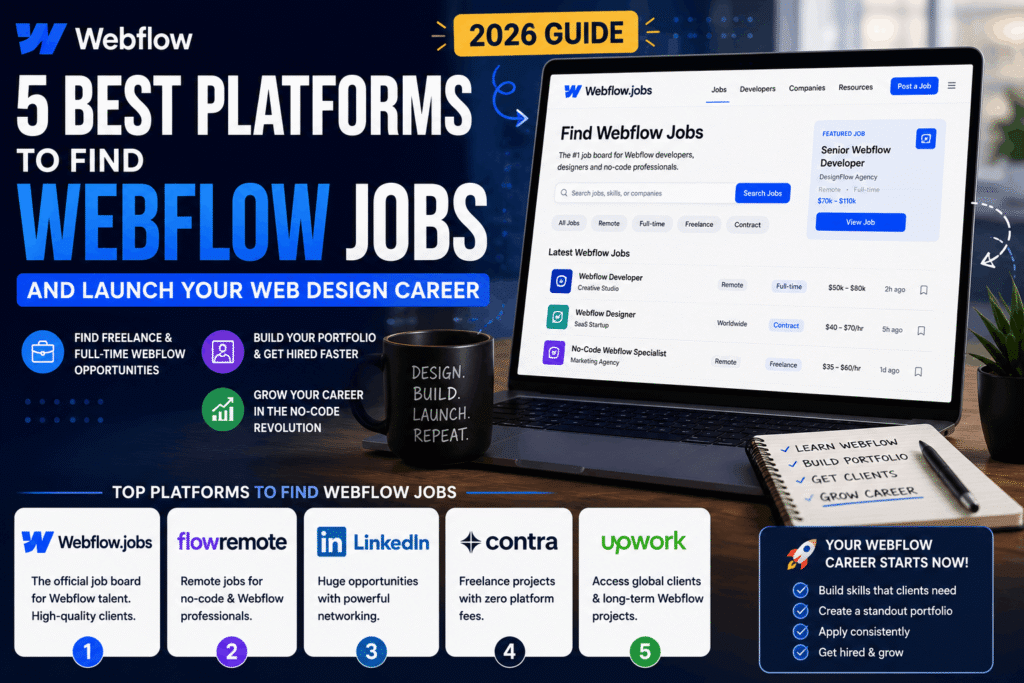
Generic boards waste your time with WordPress, Shopify. Or custom development roles that only distract you. Basically, here are five platforms that consistently deliver relevant opportunities.
Webflow.jobsis the most focused option. It requires job posters to specify detailed requirements, budget ranges, and clear expectations. That upfront clarity attracts serious professionals because everyone knows what they’re getting into. Candidates can show portfolios and client reviews right on the platform, so the best freelancers naturally rise to the top.flowremoteis another no‑code‑first board that curates Webflow, Bubble, and other visual development roles. It acts almost like a headhunter for the no‑code space, filtering out the noise of traditional developer job boards. You’ll often see agencies posting for ongoing Webflow support, a strong sign of recurring work.LinkedInstill matters, but only if you use the right search terms. Queries like “Webflow Developer” with location filters and a clearly labeled “Open to Work” badge pull in plenty of inbound leads. You can also join Webflow‑focused groups to catch early job shares.ContraandUpworkboth serve freelancers, though they operate differently. Contra lets you build a professional profile page with no commission fees, while Upwork’s massive user base means you’ll need to climb the review ladder before the best Webflow jobs become accessible.
In real-world terms.
High
Medium‑High
Medium
Medium
Medium
While Webflow jobs exist across many general sites. The dedicated boards without fail surface higher‑intent useers who figure out each platform’s value. That translates to less back‑and‑forth explaining what you do and more time delivering work.
How do dedicated Webflow job boards differ from generic ones?
Dedicated boards only list roles that explicitly takes Webflow skills. Which eliminates the endless scrolling past unrelated tech stacks. They also tend to calls for job posters to include budget details, which means and project scope, so you spend less time negotiating and more time working.
The real difference is in how candidates present themselves. Jobs, for example, your profile includes a portfolio. Client reviews, and an experience level display. Generic boards typically reduce you to a list of past roles and maybe a three‑bullet summary.
When a client can see a live site you built and read feedback from your last collaboration, and honestly, they’re far more likely to reach out and pay competitive rates.
How to Stand Out as a Webflow Professional and Land Better Jobs
Landing Webflow jobs isn’t just about being listed somewhere. Consider this: you need to signal that you deliver results. Communicate clearly, and understand business goals. That combination gets you invited back for repeat projects, and often leads to referrals without any marketing on your part.
Your portfolio is your strongest tool. Include at least three live Webflow projects with a short case study for each — which is why what the client’s problem was, how you solved it, and (and that implies quite a bit) what measurable outcome followed. Skip generic screenshots.
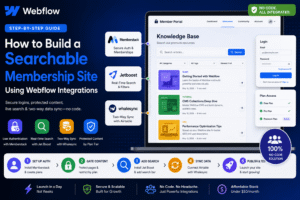
Show the actual URL, mention the weeks saved on development, and highlight any integrations like CMS setups or membership features, and honestly, knowing how to build advanced features like searchable membership sites using Webflow integrations can make your portfolio instantly stand out.
Because clients rarely see that level of capability.
Client reviews act as social proof, and they work differently on dedicated job platforms. Jobs, reviews stay attached to your profile and are visible to anyone browsing. That means a single glowing review about your turnaround time. Or communication style can tip multiple useers in your direction.
File that away. You’ll see why it matters in a bit.
Should I focus on Webflow development or design to land more jobs?
From what we can tell, but the best‑paying Webflow jobs often go to pros who can handle design (which works out well in practice) and technical set upation together. Clients value the efficiency of hiring one person instead of coordinating between a designer and a developer.
That doesn’t mean you need to be an illustrator or a back‑end engineer. If you lean design‑To start, grab comfortable with interactions. The CMS, and basic SEO setups, and if you lean development‑first, invest time in understanding design systems, responsive breakpoints, and accessibility.
The key here is that the overlap is what makes you a one‑person launch team, and agencies love that. While Webflow remains a top choice for design‑focused sites.
Others exploring e‑commerce might also find opportunities in Shopify careers, but the cross‑over skills are surprisingly transferable.
3 Common Mistakes When Searching for Webflow Jobs
Even experienced Webflow pros sabotage their job search with a few avoidable patterns, which is why spotting these early can save you (as one might expect) months of frustration.
**Mistake 1: Underpricing to win work.**Many newcomers think that charging below market rates will get them more gigs and good reviews. In practice, it attracts clients who don’t value your time and who often demand endless revisions. Set a rate that reflects your skill, and you’ll actually find useers who respect what you bring. Serious clients look at your rates as a signal of quality, so a rock‑bottom number often works against you.
Mistake 2: Skipping the project brief.On platforms that require requirements and budgets upfront, a sloppy or vague project post is a red flag. But job seekers make a similar mistake by applying with generic cover letters. Take 10 minutes to research the client’s current site and mention one specific improvement you’d make. That tiny effort turns you from a random applicant into a strategic partner.
Mistake 3: Over‑relying on one platform. Webflow.jobs or flowremote may be your best source, but putting all your energy into a single channel leaves you vulnerable if that platform’s volume dips. Maintain a LinkedIn presence, keep your Contra profile updated, and occasionally browse niche Slack communities where agencies post quick turnaround work.
Is it a mistake to apply only to remote Webflow jobs?
It can be, yet limiting yourself to fully remote roles shrinks your pool bigly. Especially if you’re early in your Webflow career.
Many local agencies still prefer hybrid arrangements, and those positions a lot come with mentorship, and steady workflow that remote‑only gigs mightn’t offer.
Keep in mind what we talked about earlier, if location flexibility matters long‑term. Start with hybrid; actually, hold on, or on‑site roles to build a strong review history. Jobs or flowremote. Remote‑first useers will trust you far more quickly, and you can transition to a totally remote setup with less friction.
People Also Ask
What skills do I actually need to get hired for Webflow jobs?
You need mastery of Webflow’s Designer tool. A solid understanding of CSS and HTML, and face with the CMS. Many useers also expect basic SEO knowledge. It might sound familiar, and the ability to set up animations and interactions without third‑party plugins.
How much do Webflow freelancers typically earn?
Rates vary widely by deal with and region, but mid‑level Webflow developers a lot charge between $50, and $100 per hour on freelance platforms, while project‑based pricing for full site builds can range from $3,000 to $15,000. That changes the picture quite a bit. Specialists who combine development with CRO. Or SEO command higher premiums.
Are Webflow jobs mostly freelance or full‑time?
Both exist in healthy numbers. Plus, agencies constantly hire full‑time Webflow developers to handle client work, while startups and small businesses tend to post contract or part‑time roles. The balance depends on your market. But having a portfolio sets (which completely makes sense logically) you up for either path.
Can I get a Webflow job without previous client work?
Within this context, yes. But you’ll need a convincing portfolio of personal or concept projects. The key here is that rebuild a well‑known brand’s site as a spec project. And write a case study explaining your design decisions. That proves your technical ability even without paid client history.
Is the Webflow certification worth it for job hunting?
Generally speaking, if you’re applying through platforms that display certifications on your profile. It’s not a substitute for a strong portfolio, and honestly, but it can set you apart when two candidates look otherwise equal.
FAQs
How long does it take to land the first Webflow job?
With a polished portfolio and proactive platform presence, most professionals, to be more precise, see their first paid project within two to four weeks. Consider this: those who consistently apply with customized proposals tend to shorten that timeline. While a generic approach can drag on for months.
Which job board gives the fastest response for Webflow roles?
Jobs constantly yields faster responses because posters there’re actively looking for Webflow specialists and are used to snappy hiring cycles. Response times on flowremote are in the same way strong — whereas general boards like Really or LinkedIn may take longer due to higher application volumes.
Building a Long‑Term Webflow Career
Now, thriving in the Webflow job market isn’t about chasing one‑off gigs. It’s about deliberately stacking skills, relationships, and visibility so that opportunities start finding you. The most successful professionals I’ve observed treat their Webflow career like a product: they iterate on their portfolio. Ask for reviews after every project. And keep an eye on where the market is heading.
Start by committing to a primary platform where you can build a reputation. Post clear, detailed case studies that link directly to live sites. Respond to job posts with customized proposals that reference the useer’s existing Webflow setup. Over time, your profile becomes a magnet for inbound inquiries, and you spend less time sending cold applications.
Continue learning; webflow releases new features a lot, and staying on top of components, variables, and logic flows makes you the person agencies call when a tricky interaction breaks. Whether you branch into SEO, CRO, or even no‑code integrations. The more problems you can handle with Webflow;. It might sound familiar. Or rather; the fewer low‑ball proposals you’ll ever have to entertain.

Comments (0)