

If you can push a responsive site live without writing code. Webflow careers have gone from niche to mainstream faster than most most of us expected, and the money is following.
In fact, about 8 in-house Webflow careers are officially open at the company itself right now. The real explosion is in the gig economy. Where skilled most of us are pulling in $110,000 to $145,000 annually or more.
The path into a stable, well-paying Webflow role isn’t obvious. If you only look (which is a critical factor) at traditional job boards. The demand is real.
The rules of the game have shifted.
Key Point
- Webflow developer full-time rates hover between $52.75 and $69.75 per hour, which translates to roughly $110,000 to $145,000 per year, depending on your location and the project’s complexity.
- The platform’s no-code foundation means you don’t need a computer science degree to build a six-figure career, but you do need to master responsive design principles and client communication.
- Only a tiny fraction of Webflow careers exist inside the company itself — most opportunities are with agencies, SaaS startups, and direct clients who post detailed briefs on platforms like webflow.jobs and ZipRecruiter.
Table of Contents
- What Webflow Professionals Really Do
- How Much Money Can You Make in a Webflow Career?
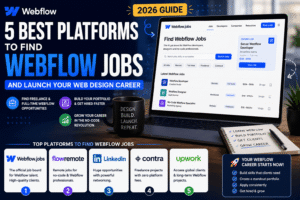
- Where the Jobs Are Hiding Right Now
- In-House Webflow Roles vs. Freelance: The Real Tradeoffs
- Skills That Command Top Dollar in Webflow Careers
- People Also Ask
- FAQs
- Your Next Move
What Webflow Professionals Really Do
A Webflow professional builds — designs — and manages websites entirely within Webflow’s visual canvas, translating client goals into live, responsive pages without needing to hand-code HTML or CSS, but there’s a catch. Now flip that around. Now, these roles blend visual design sensibility with technical platform knowledge. You’re often acting as designer, front-end developer.
SEO consultant all at once.
How does a typical Webflow project actually unfold in practice?
From kickoff to launch, most projects follow a clear rhythm: you’ll first map out a sitemap and wireframes, then build the responsive structure in Webflow. Populate content, blend CMS collections, configure SEO settings.The real skill is balancing speed with pixel-perfect responsiveness, mainly because clients expect a polished product but also want it yesterday.
The scope varies wildly, but one week you’re building a five-page portfolio for a photographer. The next you’re setting up a CMS-powered blog with active filtering for a tech startup. For the most part, you can hand off sites that perform well on Core, you know what, Web Vitals without ever writing a line (which completely makes sense logically) of backend code.
How Much Money Can You Make in a Webflow Career?
75 per hour, which pencils out to an annual salary range of roughly $110,000 to $145,000. According to recent listings on ZipRecruiter and In fact. Freelance rates can climb even higher. When you specialize in complex ecommerce integrations or enterprise landing pages.
Then again, online, you’ll see claims that anyone can earn six figures overnight.What the data actually suggests is that income scales with your ability to fix business problems.
A designer who understands conversion improvement. Or can set up a membership site integration constantly commands $85 per hour or more.
Under normal conditions, if you think about it, it’s worth remembering that location still matters, even remotely. Some full-time listings, like those in Zionsville, Indiana. Are tied to a precise geography, which impacts cost-of-living calculations. True enough, but many companies now openly hire across North America and Europe, which widens your (more on that later) bargaining power bigly.
“The highest-paid Webflow professionals don’t just build sites; they diagnose why a client’s current site isn’t converting and fix that gap in the redesign.”
If you’re transitioning from a traditional developer background. You’ll likely hit the upper range faster. Because you can combine custom code with Webflow’s visual tools, and let me tell you, for designers without coding face, expect to start around $40 per hour and increase as you master interactions and SEO settings.
Where the Jobs Are Hiding Right Now
Not all Webflow careers live on generic job boards. Jobs, where clients post detailed briefs with clear budgets, and expectations, plus ZipRecruiter and Truly, which list both full-time and contract roles, so you’ll also find steady demand on LinkedIn, Contra; and in dedicated Webflow Facebook communities.
Still, if you’re only searching “Webflow developer” on Google. You’re missing about half the market. Many companies list roles as “low-code developer,” “visual designer,”.
75 hourly range appears repeatedly, suggesting that’s a standardized market floor.
Some of the best-paid gigs almost never get posted publicly at all. They circulate inside private Slack groups.
At Webflow meetups, or through referrals from past clients. Building a reputation for reliability often yields higher lifetime earnings than improving a resume.
Store this one. It ties everything together later.
In-House Webflow Roles vs. Freelance: The Real Tradeoffs
Choosing between a salaried Webflow position at a company like — no, scratch that, Webflow itself (which now has only 8 open internal jobs). No absolute guarantees, and building your own freelance client roster is less about money, and more about lifestyle. Both paths can crack six figures.
The day-to-day work and risk profile are utterly different.
A full-time role offers stable benefits, mentorship from senior developers, and the chance to work on large-scale design systems.Webflow, headquartered in San Francisco, uses 501 to 1,000 people. The data speaks for itself. That’s not a small shift. Sound familiar?
This scarcity means you’re competing against thousands of applicants.
Freelancing gives you control over your schedule and the types of projects you take on, but it also means you’re responsible for marketing, client vetting, and tax planning. Almost every successful freelancer I’ve observed goes through a rough patch in the first six months. Where they undercharge and overdeliver. Funny enough, if you’ve been affected by recent industry layoffs. Including Webflow’s own reductions in 2026, the freelance path can serve as a step-by-step recovery plan for tech professionals.
The hybrid model works surprisingly well for Webflow professionals. Many designers hold a part-time agency role. While building a side client base. Then transition 100% when the numbers make sense.
Skills That Command Top Dollar in Webflow Careers
You can land a junior Webflow job by knowing the basics, but to break into the $100,000-plus range. You need a specific stack of complementary skills that go beyond dragging.What actually bumps up your rate is your ability to improve site speed, blend third-party options, and make content-powered decisions.
What’s the single most overlooked skill that boosts Webflow earnings?
It’s the difference between building a static brochure site.
Once you show this, your project fees usually jump by 30 to 50 percent.
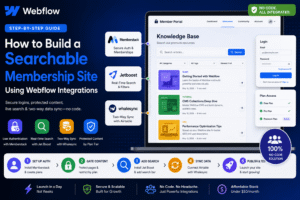
Other high-use skills include understanding SEO fundamentals (meta tags, schema, sitemaps within Webflow), connecting Zapier or Make automations, and handling membership site integrations. Like, knowing how to build a searchable membership site with Webflow integrations immediately sets you apart from designers who only do landing pages.
“If you can look at a client’s existing analytics and propose a Webflow rebuild that improves load time and conversion rate, you stop competing on price and start competing on value.”
You don’t need to become a full-stack engineer, but being dangerous with custom CSS, and JavaScript inside Webflow’s embed components opens up advanced animations. And custom calculator builds that agencies happily pay a premium for. Meanwhile, comparing job descriptions across platforms like Shopify careers reveals that Shopify careers share similar remote-work trends. And cross-platform skills can make you an even more attractive hire.
People Also Ask
Can you really make a full-time living from Webflow alone?
Yes, and many people do. 75 per hour. Make of that what you’ll.
How long does it take to become hireable as a Webflow professional?
Most focused learners land their first paid gig within four to six months… if they build a diverse portfolio alongside the Webflow University courses. The timeline shrinks if you already have a design or front-end background, but expect a couple of months to internalize the class-naming conventions and CMS logic.
Are Webflow careers only for designers?
Not at all. Developers who prefer visual solutions over endless code, SEO specialists, content strategists.
Is the Webflow job market oversaturated?
While more people are learning Webflow. The demand is still growing faster than the supply of truly skilled professionals who understand responsive design.
FAQs
Do I need a degree to start a Webflow career?
No degree is required, which means so most Webflow professionals are self-taught via free the stuff you need like Webflow University. You might disagree, and that’s fair. Though there’re always exceptions. YouTube tutorials, and community forums.
What matters is a portfolio with live, responsive sites and client testimonials.
What’s the difference between a Webflow developer and a Webflow designer?
A Webflow designer focuses mainly on the visual layout. Typography, and branding using the drag-and-drop interface. A Webflow developer a lot dives deeper into custom code embeds, API integrations.
How do I handle clients who don’t understand Webflow?
Ask yourself – this brings us back to what we started with, you sell the outcome, not the tool. Explain that you’ll deliver a blazing. SEO-friendly website they can edit themselves without touching code. Most clients don’t care about that platform; they care about the result.
Can I use Webflow for ecommerce and charge more?
Absolutely. Webflow’s ecommerce plans support product pages, checkout, and custom cart experiences, and let me tell you, being able to build a complete online store with Wix ecommerce alternatives broadens your service offering and lets you charge premium project rates.
Your Next Move
Switching focus for a On top of that, the Webflow career scene in 2026 is lopsided in a good way: demand is high, talent that can actually deliver is thin. And (depending entirely on the context) the income ceiling keeps rising.The everyone winning, hmm, let me put it differently, right now are the ones who treat their Webflow skills as a business. So where does that leave us? That changes the picture quite a bit.
- Build three distinct portfolio sites — one CMS-driven blog, one ecommerce demo, and one optimized landing page to showcase range.
- Set up job alerts on webflow.jobs, ZipRecruiter, and LinkedIn — filter for remote roles in your timezone and apply to ten per week.
- Learn Webflow CMS collections and SEO settings deeply — at least 60 percent of high-paying gigs require dynamic content management.
- Join two Webflow communities — the official forum and a private Slack or Discord group where actual hiring happens.
- Specialize in one premium integration — such as membership sites, Zapier automations, or advanced animations — to command higher rates.
- Set a minimum project rate — based on your desired annual income divided by realistic project volume, and stick to it in negotiations.
More recently, the best time to plant a tree was yesterday. The second-best time is now. The Webflow setup is still maturing. The professionals who secure their expertise today will be the ones who dictate the market rates tomorrow.
🔍 Research Sources
Verified high-authority references used for this article


Comments (0)